
AUDITORIUM
- DESIGN CONSIDERATION
- DIFFERENT FORMS OF AUDITORIUM
- LIGHTING CONSIDERATION
- ACOUSTICAL CRITERIA
An auditorium is an important area for performing art, the aim is to serve the audience.
DESIGN CONSIDERATIONS
- Layout per applicable building and life safety codes, regulations, and ordinances.
- Allow a sufficient distance between aisles for desired quantity and size of chairs plus end space.
- Space rows to allow for the proper seat-to-back clear space.
- Allow 1″ minimum clearance from either side or rear of the chair to any adjacent side wall, end walls, etc.
- Provide adequate sightlines for either sloping or stepped (riser) floor configurations. The seating area should be free of obstructions
- To allow for sufficient aisle illumination: Aisle lights are generally located in the end panel standards at least every other row. Locate aisle light junction box 6″ from the standard
- Provide adequate floor or riser materials for sound anchorage.
Seating capacity –
The maximum capacity depends upon the format selected and on aural and visual limitations set by the type of production. Other factors that influence are levels, slightness acoustic circulation, etc.
Size of an Auditorium –
An area of at least 0.5 m2 per spectator is applied. this is derived from seat width x row spacing of at least .45m2 per seat + additional space 0.05 m2 per seat.
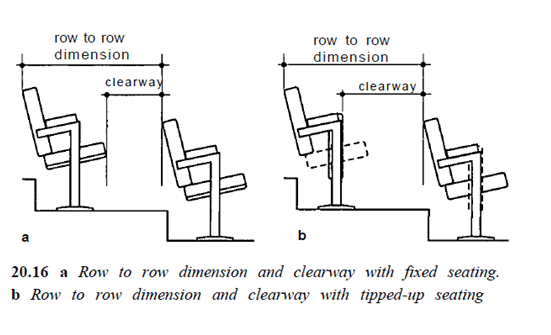
Spacing is controlled by the clearway between the leading edge of the seat (in an upright position, if tippable) and the rear of the back of the seat in front
- For traditional seating, the minimum clearway for people to pass along the row is 300 mm and this dimension increases with the number of seats in a row.
- For continental seating, the clearway is not less than 400 mm and not more than 500 mm. The legislation also dictates the minimum row-to-row dimension at 760 mm: this is usually inadequate and the minimum should be 850 mm for traditional seating.
Length of row –
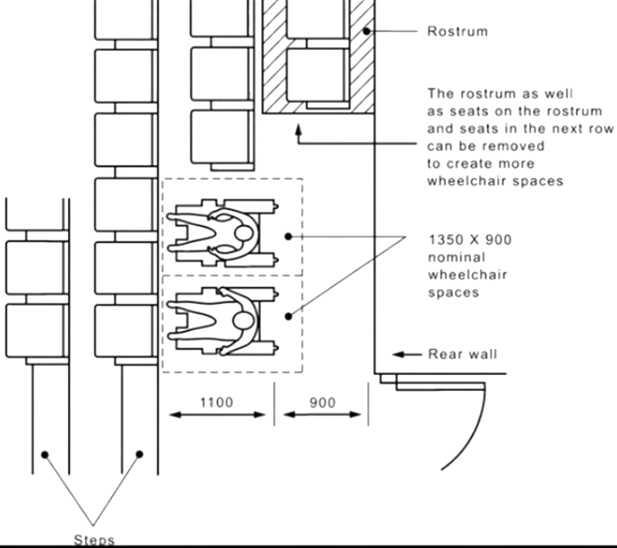
A maximum of 16 scats per aisle of 25 seats is permissible in the aisle if one side exit door of 1m width is provided.
Plan of a human head
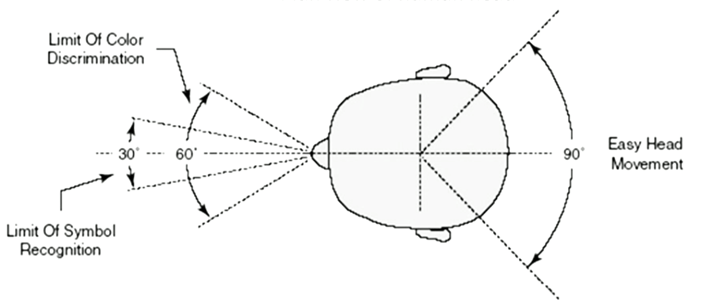
The maximum horizontal cone of vision for a man with head movement is 150 deg. (60+90 i.e head movement 90 deg. + eye discrimination 60 deg.)
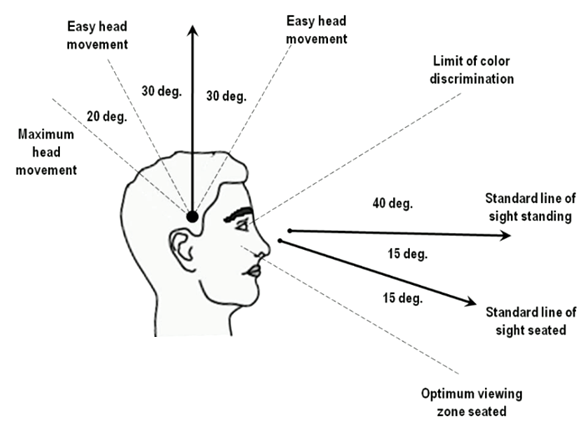
The maximum vertical cone of vision for man is 70 deg. (40+15+15)
The proportion of auditorium –
These are obtained by the spectator’s perception and good viewing angle.
- Good view without head movement, but slight eye movement of about 30
- Good view with slight head movement and slight eye movement approx. 60
- The maximum perception angle without head movement is about 110
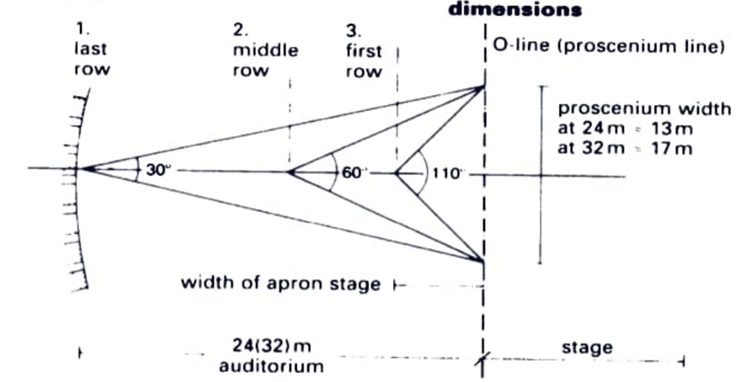
STAGE
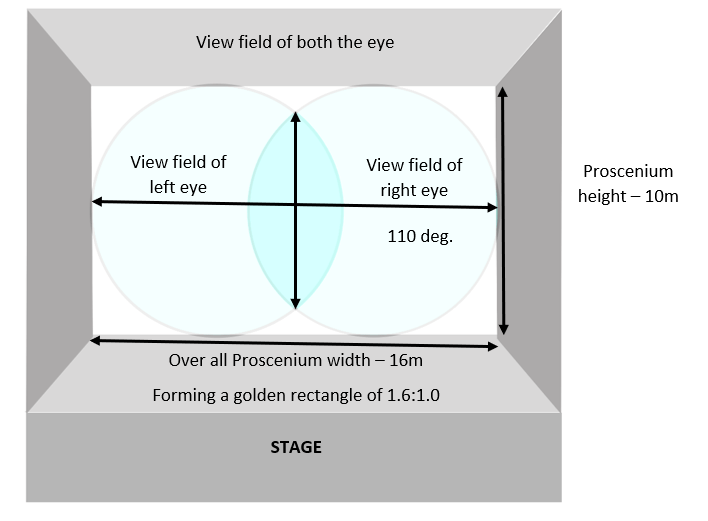
Exit escape routes – 1m wide per 150 persons (min 0.8m)
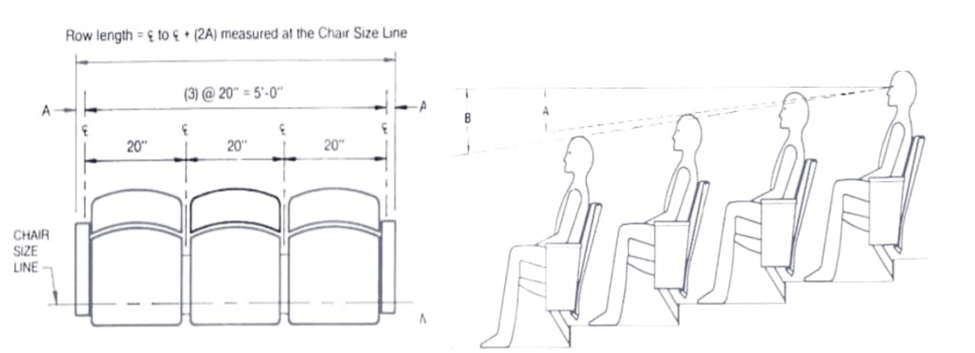
Seat width – Min. width is .45m to .6m
Angle A: Shifting position to look between heads in the row immediately in front of the spectator and over all other heads.
Angle 8: Shifting position to look between heads of two rows immediately in front of spectators and over all other heads.
Rule of thumb for seating area:
Allow 0.5m2 per Seat, including Aisles and Cross-over. This is sufficiently accurate for preliminary planning.
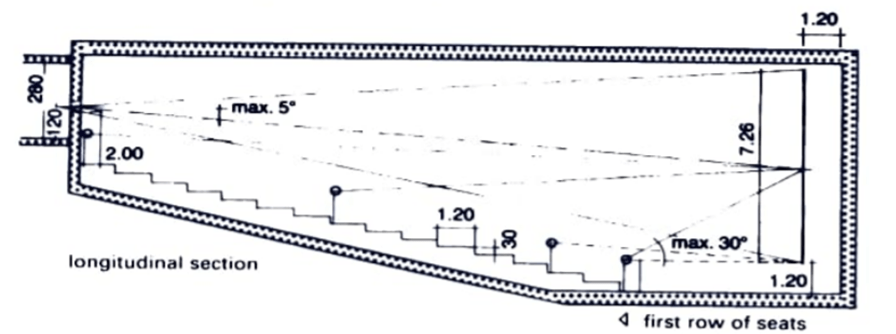
ACOUSTICAL TREATMENT
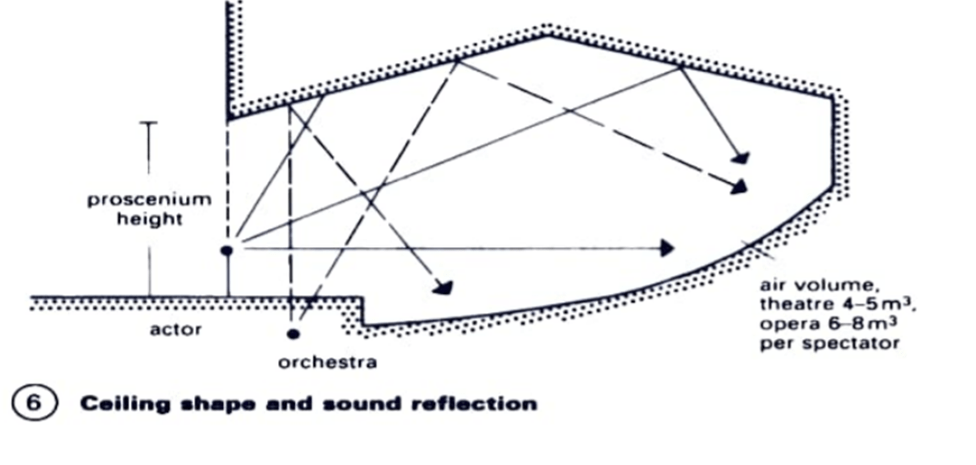
The minimum standard of sound reduction likely to be required in an auditorium in a city to protect it against external noise is of the order of 65 dB. This reduction should be provided on all sides, but it would be reasonable to make the roof insulation 5-10 dB less provided the building is not unduly exposed to noise from aircraft in-flight. Surrounding the auditorium with ancillary rooms and foyers is an obvious and invaluable planning method of obtain the required insulation against outdoor noise.
The insulation of the internal walls should be adequate to protect the auditorium from these noise sources and the insulation should not be bypassed by openings, doorways, etc. Adequate absorbing surfaces should be provided in the hall to control the reverberation.
Such areas include rear walls, balcony parapets, concave surfaces, etc. Porous materials are used for absorbing sound such materials are quilts, wool, gypsum board, etc.


 THE NEW SKELETON